
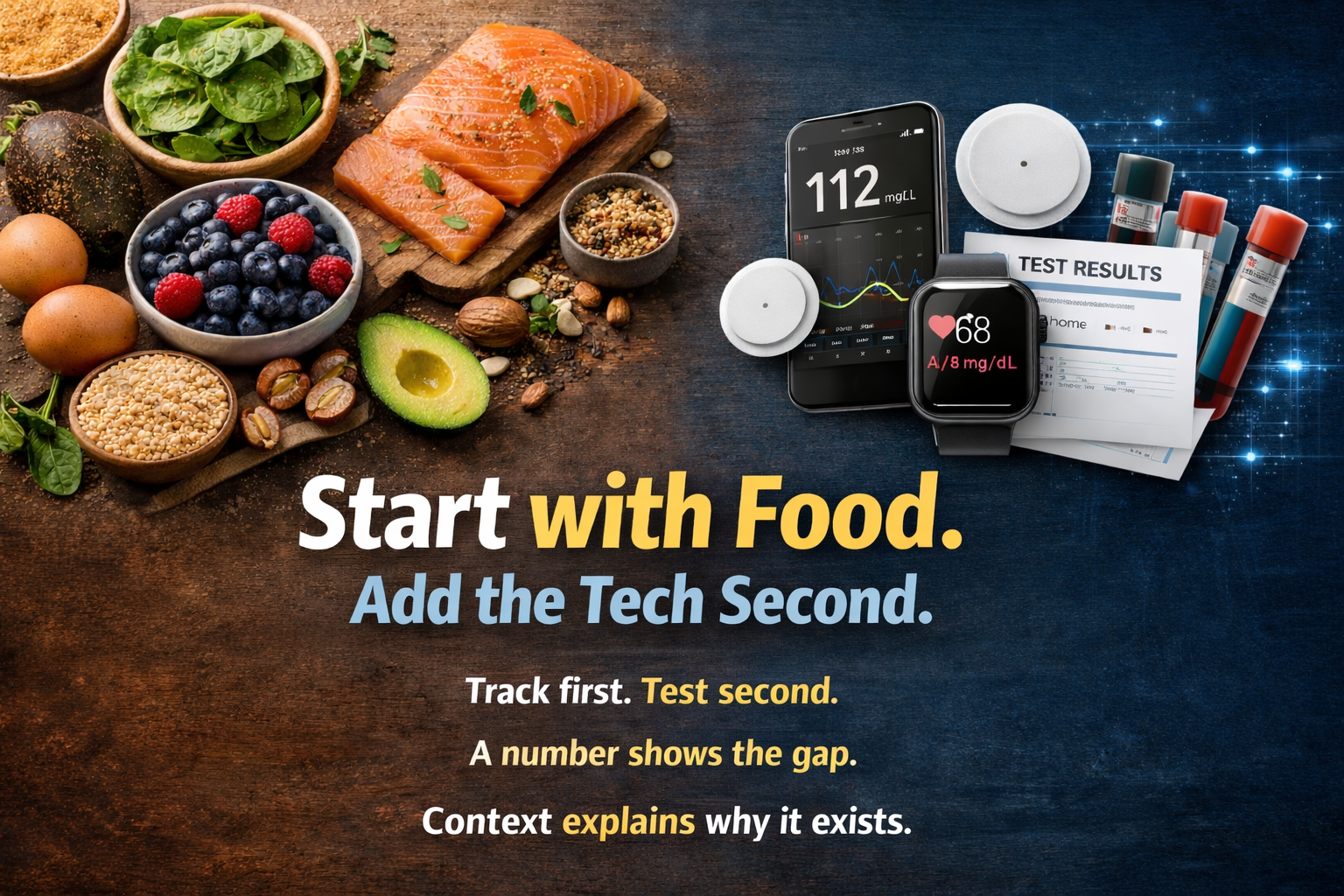
The at-home health tech market is exploding.
Continuous glucose monitors for people without diabetes. Wearables tracking heart rate variability. At-home blood panels delivered to your door. Demand could hit 2 billion units per year by 2050 42 times more than today.
The technology itself is remarkable. The sensors are accurate. The data is real. The potential is enormous.
But the way people use it is backwards.
I see this every week. Someone shows up with test results, already prescribed supplements or interventions, asking me to help them understand what’s wrong.
The first thing they say: “I got these results and was prescribed stuff to fix it, but I don’t know where the problem is. I think more needs to be tested.”
The first thing I ask: “What’s your diet like?” and then the conversation shifts.
The missing variable nobody measures
Here’s what happens when you test without context.
You get a number. Low iron. Low B12. Elevated glucose. High cortisol.
That number tells you there’s a gap. It doesn’t tell you why the gap exists.
Is it because you’re not eating enough of the nutrient? Is it because you’re eating it but something is blocking absorption? Is it because your body is stealing from one system to protect another? You can’t know. The snapshot doesn’t show the story.
Data without context is meaningless. This applies to every metric you track. Without knowing what you eat, how you eat, and what your body actually receives, test results become noise. I’ve seen people with low iron who don’t eat meat, seeds, or any iron-rich foods. The test matched the input gap. Simple.
I’ve also seen people with low iron who eat plenty of iron-rich foods. Turns out, bacteria in their gut were consuming the iron and vitamin C before their body could use it. Same test result. Completely different root cause. If you supplement without knowing which scenario you’re in, you might be feeding the problem.
Your body lies to protect you
The reason most people don’t feel terrible before things get bad is homeostasis.
Your body is a regulator. It takes from one pot and puts it into another to keep you alive. The brain prioritizes survival over optimization.
Take magnesium. When intake or absorption is too low, your body protects blood calcium first. Calcium is needed for nerve signaling, muscle contraction, cardiac rhythm. So bone becomes the pot that gets robbed.
Parathyroid hormone rises. Bone resorption increases. Kidneys conserve calcium. Phosphate tends to fall. Serum calcium can stay normal or low-normal for a while. A normal calcium value can falsely reassure you. You think everything is fine. Meanwhile, your bones are being stripped to maintain the system.
This is why you don’t get an early warning. Your body is working overtime to keep the lights on. By the time you feel it, the deficiency is deep. Testing without tracking what goes in just shows you the damage. It doesn’t show you how to stop it.
The CGM problem
Continuous glucose monitors are a perfect example of technology being used without the right foundation.
CGMs were designed for people with diabetes. They need real-time glucose data to manage insulin. The technology is life-saving in that context. Now they’re being marketed to healthy people as a way to “optimize metabolism” or “catch early warning signs.”
The problem? CGMs overestimate blood sugar levels in healthy adults. Researchers found that CGMs estimated “time out of range” as four times higher compared to capillary blood testing.
People without diabetes misinterpret normal postprandial spikes—the natural rise in blood sugar after eating—as warning signs. They restrict their diet. They develop anxiety. They show up at the doctor for something that’s biologically normal.
One review stated plainly: Commercial claims suggesting the utility of CGM devices in people not living with diabetes should be labeled as misleading. There’s a lack of consistent, high-quality evidence to support their use for early detection, behavioral change, or metabolic health improvement in healthy populations. The technology works. The application is wrong.
False positives and healthcare overload
Wearables create another problem: false alarms.
Only 11% of people who received abnormal pulse alerts from wearable devices received a clinically actionable diagnosis. That means 89% of alerts led to unnecessary worry, doctor visits, and tests.
The American Academy of Neurology released guidelines warning that wearable devices may produce falsely alarming or falsely reassuring results and may have unintended effects like increased anxiety. They emphasized that users must understand device limitations and not use them as a substitute for medical care. Wearables surface patterns. Clinicians need those patterns. The majority of clinicians are flying blind between clinic visits, but wearables can surface micro-patterns in sleep disruption, activity drops, or stress spikes.
The problem is when individuals interpret those patterns without knowing what’s normal for their body, what’s situational, and what actually requires intervention.
What You Should Do Instead
Track first. Test second.
When someone comes to me, I tell them to use the app for three weeks.
First week: eat like you usually do. No changes. Just visibility. This creates a baseline.
Second and third week: try the suggestions the app gives you. See how you feel. If you can, go another week.
This process shows me what you eat, what you’re missing, what you eat too much of, and whether your body responds when you adjust inputs.
If the intake doesn’t match the test result, that’s my signal to go deeper. If someone is eating plenty of iron-rich foods but still shows low iron, there’s a reason. Maybe it’s absorption. Maybe it’s gut bacteria. Maybe it’s chronic inflammation.
But I can’t know that from a snapshot. I need the story. Testing without tracking is like diagnosing a car problem by looking at the dashboard light without checking the engine.
Supplements are backup, not foundation
People ask me all the time if they should take a specific supplement.
My answer depends on the form. Is it synthetic? Natural? Oxide? Bioavailability matters. But before we even talk about form, I need to know if you need it at all.
The order is: Track first. See how you eat on your baseline. Then try to eat more of what you’re missing. Try to eat less of what you’re overdoing. If for some reason you’re still missing nutrients, then you supplement.
Or you supplement in times of acute need. High stress periods. Recovery. Illness. Supplements support. Food sustains.
I’ve reversed a case of juvenile arthritis by removing pathogens that thrived on raspberries and blueberries. The mom had been giving her daughter those foods constantly because she thought they were anti-inflammatory. Three hospitals never did an organic acids test. The girl never had arthritis markers. Just inflammation.
When we treated the pathogens, she stopped the bi-weekly injections. I’ve seen a woman in her late twenties reverse decades of urticaria through food. She’d had it since childhood. Gone.
These aren’t miracles. They’re what happens when you complete the loop.
The system isn’t built for this
I spent a week in Texas visiting hospitals, universities, and healthcare systems. Every institution talked about innovation. Every one of them had venture arms, accelerators, AI investments. Billions flowing into digital health and precision medicine.
But here’s what I saw: the U.S. healthcare system is not primarily designed for health. It’s designed for volume, billing, and profit retention.
Everyone talks about value-based care. In practice, most institutions still operate on fee-for-service incentives. Every admission, scan, or test is a revenue event. The system rewards activity, not outcomes. There’s a visible tension between what providers say, “we’re transitioning to value-based care”, and what they do: continue to build new hospitals and increase procedural volumes.
Value-based care has become compliance language. Medicare and private insurers penalize hospitals for re-admissions, preventable complications, and poor quality metrics. So hospitals adopt the rhetoric to avoid penalties. But the internal culture and financial structures don’t support actual prevention.
Here’s the paradox: everyone agrees prevention is better, cheaper, and more humane. But no one knows who will pay for it.
Hospitals don’t profit from fewer patients. Insurance companies won’t fund preventive measures with delayed returns. Employers struggle to tie wellness programs to measurable cost savings. So innovation happens, but only within the safe boundaries of profitability.
The system will innovate as long as it doesn’t disrupt revenue.
Where this fits
I’m not trying to break the system. I’m positioning inside it as the bridge between where it is and where it needs to go.
At-home health tech is here. It’s not going away. CES 2026 marked a pivot where health showed up with action rather than as a metric. The most compelling innovations didn’t ask people to engage more with technology. They faded into the background. The goal shifted from devices that report outcomes to tools that foster proactive treatment.
That’s the right direction. But action without context still fails. You need to know what your body is receiving before you can interpret what it’s missing. The technology is amazing. The sensors work. The data is real.
You just need to use it in the right order.
Track your inputs. Build your baseline. Then test to confirm what the data already suggested.
That’s how you turn a snapshot into a story. That’s how you move from intervention to investigation. That’s how you stop feeding the problem and start solving it. The loop needs to be completed: underlying conditions, current state, stressors, personal data, wearables, nutrition; all integrated.
Right now, most people test and supplement based on what’s missing. But if you don’t know why it’s missing, you might be making it worse. Low iron, iron pills, bacteria that thrive on iron. You just fed the problem.
The technology exists. You’re using it backwards. Start with food. Add the tech second.
That’s when the data becomes useful.