
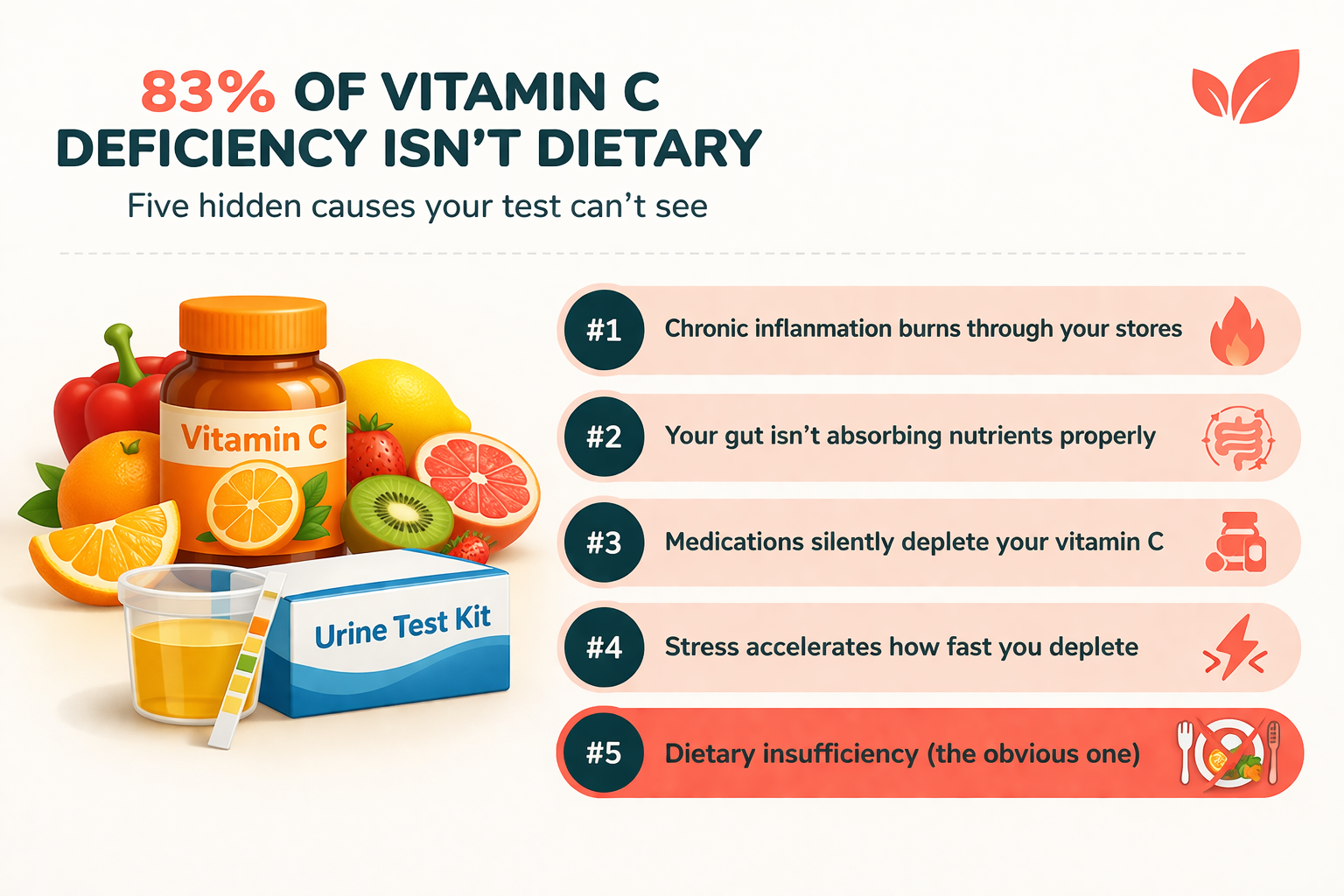
You get a low vitamin C result back from your home test kit. The next logical step feels obvious: order a supplement, start taking it daily, retest in a few months. But here’s what most people don’t realize: that low number doesn’t tell you why you’re deficient. And without knowing why, you’re solving the wrong problem.
The body doesn’t work in snapshots
A single test result is a moment frozen in time. It shows you where your levels are right now, but it tells you nothing about the forces that got you there. Research shows that only 17% of vitamin C variance comes from dietary intake alone. That means 83% of what determines your vitamin C status has nothing to do with how many oranges you ate this week.
The rest comes from inflammation, oxidative stress, medications, gut absorption, chronic conditions, and how your body responds to daily stressors. Your test result captures the outcome. It doesn’t capture the mechanism.
Five feasons your Vitamin C could be low (and only one is about food)
1. Chronic inflammation is burning through your stores
When your body is inflamed, it uses vitamin C faster than you can replace it. Fever, infection, autoimmune flares, even low-grade systemic inflammation from poor sleep or stress all increase your vitamin C needs dramatically. Studies on COVID-19 patients found that 70-80% had vitamin C deficiency during acute illness, even when their diet hadn’t changed. They could eat alot of citrus but the inflammatory response depleted their stores faster than food could replenish them.
2. Your gut isn’t absorbing what you’re eating
You can eat a perfect diet and still be deficient if your digestive system isn’t extracting nutrients properly. Conditions like inflammatory bowel disease, celiac disease, or even temporary gut inflammation from food sensitivities create a bidirectional problem: the condition depletes nutrients, and the nutrient deficiency makes the condition worse.
Taking a supplement won’t fix absorption. You’ll just create expensive urine.
3. Medications are silently depleting your levels
Prescription and over-the-counter drugs can gradually drain micronutrients over months or years. The depletion happens so slowly that you don’t connect the symptoms to the medication. Research on drug-nutrient interactions lags behind drug-drug studies by a factor of 100. Most healthcare providers aren’t trained to recognize these patterns.
If you’re on long-term medication and you’re deficient, the supplement might just be compensating for an ongoing drain you haven’t identified.
4. Stress is changing how your body uses vitamin C
Physical and psychological stress increase vitamin C requirements. Surgery, burns, smoking, extreme temperatures, even chronic anxiety all accelerate how fast your body oxidizes and uses up its stores. Your body’s vitamin C pool can be depleted in 1-3 months under these conditions. If the stressor is still present, supplementing without addressing the root cause means you’ll stay in a cycle of depletion and replacement.
5. You’re actually not eating enough vitamin C-rich foods
This is the only scenario where a supplement alone might solve the problem. But here’s the issue: if you don’t track what you’re eating, you can’t know if this is your problem or one of the other four. And most people assume it’s dietary when it’s not.
Why guessing wrong costs you more than money
When you supplement without understanding the cause, three things happen.
First, you mask the symptom without addressing the mechanism. Your levels might improve on paper, but the underlying issue continues unchecked.
Second, you waste time. Months go by while you think you’re solving the problem, but the real cause is still draining your stores or blocking absorption. Third, you lose trust in your own ability to fix things. The supplement didn’t work, so you assume your body is broken in some unfixable way. You stop looking for answers because you’ve already tried the obvious solution.
But the solution was never obvious. It just looked that way because the test result was incomplete.
The missing variable: what you’re actually eating
Here’s the asymmetry that most testing companies ignore:
A test without food data is a diagnosis without context.
If you’re eating 200mg of vitamin C daily from whole foods and you’re still deficient, that tells you something completely different than if you’re eating 20mg. The first scenario points to absorption issues, inflammation, or medication interactions. The second scenario points to dietary gaps.
Same test result. Opposite solutions.
Without tracking your nutrition, you’re forced to guess. And most people guess dietary insufficiency because it’s the easiest variable to change. But when the real problem is gut inflammation or chronic stress, adding a supplement does nothing except create false confidence.
What happens when you add the second data stream
When you layer continuous food tracking over periodic testing, the picture sharpens. You see patterns you couldn’t see before.
🍃 You notice that your vitamin C levels drop during high-stress weeks even when your diet stays consistent. That points to stress-related depletion.
🍃 You see that your levels stay low despite eating plenty of vitamin C-rich foods. That points to absorption or utilization issues.
🍃 You realize your levels improve when you remove a medication or address an underlying inflammatory condition, even without changing your diet.
The test result stops being a mystery and starts being a navigational tool.
The difference between measurement and intelligence
Most at-home testing gives you measurement without intelligence. You get a number. Maybe a reference range. Sometimes a recommendation to supplement.
But you don’t get the context that turns that number into actionable insight.
Intelligence requires at least two variables: what’s happening inside your body and what’s going into it. When you track both, you stop guessing and start solving. You know whether to change your diet, address inflammation, investigate absorption, review your medications, or manage stress differently. The test result becomes useful because you’ve given it the context it needs to mean something.
Is this just about vitamin C?
Nope. This isn’t just about one nutrient.
The same logic applies to iron, magnesium, B vitamins, omega-3s, and every other micronutrient people test for at home. A low result without dietary context is incomplete information. And incomplete information leads to incomplete solutions. You end up with a supplement routine that’s compensating for problems you haven’t identified, while the real causes continue unchecked.
The body doesn’t work in isolated variables. It works in systems. And systems require context to understand.
What changes when you stop guessing
When you combine testing with continuous nutrition tracking, you shift from reactive supplementation to root cause resolution.
🍃 You stop throwing solutions at symptoms and start addressing mechanisms.
🍃 You stop wondering why the supplement didn’t work and start understanding what your body actually needs.
🍃 You move from confusion to clarity, from guessing to knowing, from managing symptoms to reversing deficiencies.
The test result doesn’t change. But what you do with it does.
And that’s the difference between measurement and intelligence.
Try it for yourself today 👉🏽 https://orthofoodie.app/for-individuals/start-free-trial/